The post Introduction to coffee presentation appeared first on Maillardreaction.org.
]]>Me and my team did it to inspire and, more importantly, to create the tactics and details around how you, your organization, your startup can know more about start working on coffee business.
However this deck continues my tradition of training step-by-step guides that give you the exact information I’ve used to run my introduction to coffee class. That includes references like :
Coffee Origins . Biology of coffee plant . Coffee’s Growing Region . Coffee’s Journey . Current Coffee Industry . Coffee origin . How coffee is traded . Species . Varieties . cultivar . Harvesting . Processing . Processing Flavor Description . Quality Control . Roast Process . effect on taste . Roasting graph . Different roast style . storage . Coffee freshness . Humans Senses . Taste . SCA Flavor Wheel . Effect of geographical position on coffee flavor . Cupping . How to do coffee cupping . Brew methods . Brewing parameters . Filter material . Coffee extraction definition . Water Quality . What is Specialty Coffee / Organizations in Specialty Coffee / waves /.

The post Introduction to coffee presentation appeared first on Maillardreaction.org.
]]>


The post 8 tips to have a better experience of making coffee appeared first on Maillardreaction.org.
]]>The post Interview With Professionals (ALAN BRUCE) appeared first on Maillardreaction.org.
]]>
Today we have this honor to be with MR. ALAN BRUCE who catch finals in coffee competition such as barista, brewing and cup taster in new Zealand since 2016- and he went to semifinal last year. Alan is from Flight Coffee that is located in New Zealand and as I remember Flight Coffee was the first specialty coffee provider in that region. if you search about them you’ll see they’re all professionals and they serve absolutely high quality coffee.
How and When did you first move into this business?
I’ve been involved in Hospitality since I was 15 working in my local hotel in the Scottish Highlands. I started to focus on coffee after moving to NZ and in 2013 became a Barista Trainer for a local chain of specialty cafes. After a few years of competing I was approached by Flight Coffee and joined the team here.
What motivated you to become a competitor as long as you’re so busy in your company?
I’m a big believer in competitions as a force for personal and professional development. I think you learn something valuable every time you compete, so it’s important to make time to grow – even when you’re busy.
Do you had any coffee mentors or you just roll on base on experience and self-learning ? and which one is better in your opinion?
I’ve competed with and without mentors before, but the times when I’ve performed the best have been with coaching. It makes any training more effective, because you have an extra set of eyes on each performance, help with setting up and cleaning up, etc. The process of improvement becomes much faster. It’s also important to have constructive criticism right through your training – When I work by myself, I tend to go so far down one path before showing anyone where I’m at. Then when they suggest improvements, I might have to change quite a lot of what I’ve already spent a lot of time working on. When you have another person or people as a sounding board, you can get yourself to those good ideas with a lot less wasted effort.
Where did you get the idea of competing in coffee ?
I entered my first competition because I had far too high an opinion of my skill set! I signed up a few weeks before the competition and had no idea what I was getting into – I didn’t know the rules, I didn’t know what I was being scored on. I came dead last, but it really opened my eyes to how little I actually knew about the product that I worked with every day.

what did you learn of the competition? why are you competing? It’s works for what? Why you wouldn’t be a judge?
I learned that I had a long way to go before I could call myself a coffee professional, and I’ve continued to compete to prove to myself that I’ve progressed on that path. I’ve avoided judging in the past because I know how much pressure there is on judges to perform well too. I’m still a little wary of considering myself an ‘expert’ after my first time competing – I’d hate for my first time judging to go the same way! But ultimately, I also enjoy the atmosphere backstage at competitions and having the time to connect with the other competitors, which you can’t do so much as a judge.
As a cup taster and roaster, you can make lots of challenges for yourself to keep the consistency stable, is it possible? how the cup taster competition helped you in this business?
As a roaster, consistency is the highest goal for me. It doesn’t matter how good one roast of a coffee is if I’m not able to repeat it. We now have three roasters on our team, so it’s more important than ever that we maintain a high degree of consistency across our roasting – We have strict protocols to ensure that the three of us are operating in the same manner and achieving the same results. Since we started more focused practice around Cup Tasters triangulations, we’ve all become more adept at spotting inconsistency between batches, which makes us work even harder towards eliminating those inconsistencies.
what did you do to find the difference in the those 3 cup at 8 session with a lot of different algorithm? What was your personal method? What did you focus more on it?how you controlling your stress on the stage?
I think the easiest way to control stress is being prepared. You should have practiced so much that you’re almost bored of doing it by the time it comes around. For Cup Tasters we started with very easy triangluations once a week. Once we were confidently getting 7 or 8 right, we made it harder. By the week before the competiton we practiced multiple times every day with incredibly difficult triangulations (tiny variations in the cups, different roasts of the same coffee etc.) When I started tasting the coffees at the national competition, I couldn’t believe how easy it was in comparison and my nerves disappeared! If you’re worried about doing it in front of a crowd, get some friends in to watch you practice.

Whole sensory process and cupping is a bit different in compare to cup taster competition , what do you think and how you can connect them? (For example maybe somebody is really good in cupping and calibration but cannot be good at cup taster competition)
There’s definitely a difference in how you need to process the sensory information that you’re receiving. When I’m cupping, with each slurp, I’m focusing on an individual attribute of the cup such as flavour, or acidity, or body and assigning it a score based on a mental database of every coffee I’ve ever tasted. I’m also trying to accurately describe the qualities of that attribute based on a personal library of sensory experiences. For Cup Tasters, with each slurp I’m taking a mental snapshot of the cup and holding it in my mind then comparing it to the next cup. You’re using the same data but in a different way. I think for some experienced cuppers it can be hard to turn off that part of the brain that’s performing that deeper analysis which makes it difficult to make a quick decision. I think there’s also something about the pressure of being timed that affects people’s peformance.
if somebody tells you that imagine you can do whatever you want like a dream to design a coffee competition, what do you design? Do you have any idea about it? Did you think about it before? What kind of competitions do you like to have?
I’ve thought about it occasionally and we’ve designed small things to run as in-house competitions for our customers. I think the ideal format for me is something that tests knowledge, service and ability on a level playing field – I love the Barista Championship format, but it definitely favours those with access to the most exclusive coffees, and who can afford the time to dedicate to training – which is not something that every barista has. I’d probably design something a little more democratic, that really tests the skill that a barista uses every day. Something like Coffee Masters is pretty close to ideal in my mind.
As a finalist explain your opinion about these words:
First competition:
Your first competiton is both the most important and the least important one you’ll ever enter. Most important because without it you’ll never compete, and least important because it’s basically just a tryout for all your future entries.
Team:
The most important thing. No one wins by themselves. You don’t need a huge team, but you need a dedicated team. A person or people you can rely on will push you further than you can go by yourself.

How many times will you read rules and regulation before competition?
as I know most of the competitors lose a lot of points because they don’t read the rules properly.I never stop reading them! I have a printed and highlighted copy of the rules on hand at all times whenever I’m training or coaching – Even for competitions I’m familiar with. They’re they key to everything! It’s like being given the questions you’re going to be asked on a test ahead of time.
I always believe in the competition process you must enjoy the journey like when you practice, chatting with the teams, passing the level to the final and even the announcement moment, how was it for you?
If you’re only competing to win, then you are going to be disappointed with anything other than 1st place. I’ve seen people get very angry with themselves or at judges when they don’t do as well as they expected, and it just seems very at odds with what is supposed to be a celebration of excellent coffee. My advice is to focus on the process more than the result, because it’s the process of preparing for the competition that makes you more knowledgable or more skilled, not a trophy. I was a little disappointed not to make the Finals for the World Cup Tasters Championship this year, but when I consider how much my palate has improved over the course of my training, I’m incredibly proud of what I was able to achieve.
After you advanced, what is your favorite part of competition?
I enjoy the buzz backstage and talking with other competitors more than the competition itself – If I’m not competing, I’ll often MC the event, so that I still get a chance to do that!
which competition is your favorite and why?
I like them all really! I like that the results for Cup Tasters are so cut-and-dried. You either get it right, or you don’t. There’s no subjectivity in the judging. But with that, there’s no room for creative expression so the other competitions have that advantage.
some Technical question:
How do you analyze and describe acidity and sourness?
In terms of analysis, I focus on the physical sensations on my tongue, and how my saliva glands are responding. For descriptions, I try to rate intensity on a high-to-low scale, as well as a qualitative descriptor (sparkling, bright, etc.). Where possible, I’ll try and identify the specific acidity (malic, citric, etc.) or at least assign a real world facsimile (gooseberry-like, , etc.)
Light roast or medium roast, which do you prefer and why?
It’s hard to say. I think often those terms mean different things to different people. What I would say is I prefer the roast that delivers the most sweetness without compromising acidity or promoting ‘roasted’ flavours. That will also depend on whether I’m roasting for espresso or filter.
Are you cup and score coffees separate by origin and process or you mix them and cup blind?
Usually we’ll cup by origin when we receive a lot of pre purchase samples, but we’ll cup blind and in a random order – So all the samples might be from Colombia, but region and process will be mixed up.
The post Interview With Professionals (ALAN BRUCE) appeared first on Maillardreaction.org.
]]>The post Coffee Competition appeared first on Maillardreaction.org.
]]>
Coffee competition
(some of the information are from WCE site)
Coffee competitions are the epitome of the best coffee. Whether it’s a regional, national, or world championship, they will stretch you to your limit. By participating, you’ll hone your skills and discover how great your love for coffee really is. I’ve had the privilege to compete, judge, and coach in barista, brew, Aeropress, cup taster, roast, Cezve and latte art competitions over the last ten years. Getting up on that stage is no easy task, but I believe any coffee person who sets their mind to it can achieve it. Because competing is about more than technical skills. It’s also about attitude, mentality, lifestyle and what ability that you have but you don’t know, you can just sort it out by being on stage. So let me take you through what attitudes you need to achieve your best – whether in any kind of competition or simply in your daily coffee shop routine.
First, you need to know the most important coopetition in all around the world and the old one is which holding by WCE,

World Coffee Events (WCE) is an event management organization registered in Dublin, Ireland. WCE was originally founded in 2011 by the Speciality Coffee Association of Europe and the Specialty Coffee Association of America, which have since unified to become the Specialty Coffee Association. The current WCE portfolio includes the World Barista Championship, the World Cup Tasters Championship, the World Latte Art Championship, the World Coffee in Good Spirits Championship, and the World Brewers Cup, as well as features such as All-Stars, the Espresso Bar, and the Brew Bar. WCE is supported by a robust group of volunteer committee members. These members collaborate on, generate, and refine many materials, processes, and documents that help support our mission statement. WCE’s committees are critical to helping develop and shape the organization, and in supporting our strategic initiatives. Annual working groups may also be formed to help with specific projects related to one activity or championship. A volunteer leadership team designed to address competition needs and questions at the highest levels, interfacing with the SCA Board of Directors and other internal and external groups. Assists in developing format and strategic planning for all of the championships, including rules, regulations, judges, communications, and marketing. This group brings together long-time competition experts from many perspectives, meeting throughout the year to consider how to keep the competition formats moving forward with our industry.

The World Barista Championship (WBC)
is the preeminent international coffee competition produced annually by World Coffee Events (WCE). The competition focuses on promoting excellence in coffee, advancing the barista profession, and engaging a worldwide audience with an annual championship event that serves as the culmination of local and regional events around the globe. Each year, more than 50 champion competitors each prepare 4 espressos, 4 milk drinks, and 4 original signature drinks to exacting standards in a 15-minute performance set to music. WCE Certified Judges from around the world evaluate each performance on the taste of beverages served, cleanliness, creativity, technical skill, and overall presentation. The ever-popular signature beverage allows baristas to stretch their imagination and the judges’ palates to incorporate a wealth of coffee knowledge into an expression of their individual tastes and experiences. The top 15 highest-scoring competitors from the first round, plus wild-card winner from the Team Competition, advance to a semifinal round. The top 6 competitors in the semifinal round advance to the finals round, from which one winner is named World Barista Champion!


The World Latte Art Championship
highlights artistic expression in a competition platform that challenges the barista in an on-demand performance. For the preliminary round of the championship, baristas produce a single creative latte pattern at the Art Bar, then move to the WLAC stage to create two identical free-pour lattes and two identical designer lattes (which allow etching and decoration). Scores from the Art Bar and Stage are combined, and the top 12 qualify for the semi-final round, where competitors make two matching sets of different free-pour latte patterns, and one matching set of free-pour macchiatos. The top six semi-finals competitors qualify for the final round, where competitors make two different matching sets of free-pour latte patterns and one matching set of designer lattes. The top-scoring competitor in the final round is declared the World Latte Art Champion. Baristas are judged based on visual attributes, creativity, identical patterns in the pairs, the contrast in patterns, and overall performance


The World Cup Tasters Championship
awards the professional coffee cupper who demonstrates speed, skill, and accuracy in distinguishing the taste differences in specialty coffees. Coffees of the world have many distinct taste characteristics and in this competition format, the objective is for the cupper to discriminate between the different coffees. Three cups are placed in a triangle, with 2 cups being identical coffees and one cup being a different coffee. Using skills of smell, taste, attention, and experience, the cupper will identify the odd cup in the triangle as quickly as they can. A total of 8 triangles are placed in each round. The top 8 competitors with the most correct answers and the fastest time proceed to the next Semi-Finals round. Then the top 4 will compete again in the Finals round to determine the next World Cup Tasters Champion.


The World Coffee Roasting Championship
debuted 2013 in Nice, France. In this 3-stage event, competitors are evaluated on their performance evaluating the quality of green coffee (coffee grading), developing a roasting profile that best accentuates the desirable characteristics of that coffee, and on the ultimate cup quality of coffees roasted.


The world Cezve/Ibrik Championship
(also known as ibrik) is a pot designed A still from a previous Cezve/Ibrik Championship specifically designed to make a particular style of coffee that is largely consumed in parts of Eastern Europe, the Middle East and North Africa, The body can be made of metal, brass, copper, or ceramic but it features a distinctive long handle and a brim that is designed to serve the coffee. This event showcases the Cezve or Ibrik preparation of brewing coffee, set in a competition format that celebrates the cultural tradition. In this championship, it is encouraged that the competitors bring their own style/cultural element to their performance to showcase what is one of the oldest forms of preparing coffee.


The World Brewers Cup competition
highlights the craft of filter coffee brewing by hand, promoting manual coffee brewing and service excellence. In this Championship, competitors prepare and serve three individual beverages for a panel of judges. The Championship consists of two rounds: a first-round and a finals round. During the first round competitors complete two coffee services – a compulsory service and an open service. For the compulsory service, competitors prepare three beverages utilizing whole bean coffee provided to them by the competition. For the open service, competitors may utilize any whole bean coffee of their choosing and must also accompany their beverage preparation with a presentation. The six competitors with the highest score from the first round will go on to compete in the finals round consisting exclusively of an open service. One competitor from the final round will be named the World Brewers Cup Champion.


The World Coffee in Good Spirits Championship
promotes innovative beverage recipes that showcase coffee and spirits in a competition format. This competition highlights the barista/barkeeper’s mixology skills in a setting where coffee and alcohol go perfectly together. From the traditional Irish Coffee (with whiskey and coffee). to unique cocktail combinations. During the preliminary round, competitors produce four drinks – two identical hot/warm coffee and alcohol-based designer drinks, and two identical cold coffee and alcohol-based designer drinks. The six competitors with the highest preliminary round scores will compete in the final round. The final round requires competitors to produce two Irish Coffees and two coffee-and-alcohol-based designer drinks. The highest-scoring final round competitor will be named the World Coffee in Good Spirits Champion.

Now, this is all about what happened on the coffee planet about coffee competition, there is a lot of fun competition in another hand like barista League (the Barista League isn’t like the Barista Championship. But it isn’t trying to be. The latter requires extensive preparation, customer service, and 12 truly special drinks. It’s a rigorous competition that demands everything a competitor’s got. But the League will put baristas on the spot, quizzing them on general knowledge, asking them to develop recipes for mystery coffees, and seeing how many coffees they can make with alternative milk within a time limit. It’s challenging, and it’s also fun)

and also coffee masters (Coffee Masters is the fast-paced, multi-discipline global barista tournament taking place twice a year. The competition sees some of the world’s best baristas compete head-to-head in a series of disciplines for the prestigious Coffee Masters title and a £5,000 cash prize in London, and $5,000 cash prize in Los Angeles.)

Now chose one, do you want to compete or no? do you want to make a challenge for yourself? Or may you want to be a judge? all are fun but serious at that moment.
The post Coffee Competition appeared first on Maillardreaction.org.
]]>The post How you can make a better pour over coffee appeared first on Maillardreaction.org.
]]>
The pour over method involves pouring hot water through coffee grounds in a filter. The water way through the coffee and filter into a mug. Pour over is also known as filter coffee or drip coffee, although these terms also include batch brewers. What sets pour over apart is that it is made by hand-pouring the water over the coffee. So you may hear it called hand brewing or manual brewing.

Pour over accentuates intricate flavors when compared to other brewing methods, because of the shape and the material of filter, This makes it a popular choice for single origin coffees, since it allows the flavors and aromas to shine.
Good filter coffee is clean, clear, and consistent. This is because the water is allowed to extract coffee oils and fragrances in its own consistent time and at its own pressure. The filter then catches a lot of oils, leading to a clean cupAnd because this is an infusion method, it is a little more efficient at extracting coffee solubles than immersion techniques such as the French press. Immersion methods cause the water to become saturated, whereas pour overs use a constant supply of fresh water.all infusion methods (including espresso) run the risk of channeling, where a stream of water finds an easy route around the ground coffee. This happens when there are clumps of coffee or the grounds are unevenly distributed, and it means that some of the coffee doesn’t get extracted. So it’s important that baristas learns how to pour in a way that evenly immerses the grounds in water.Because it is difficult to replicate a method precisely every time, some café owners and brewers prefer to use SCA-approved batch brewers instead. These machines bring automation to the method and can have more consistent results than a hand pour. We need some equipment for make the best cup of coffee easy : • Brewing Devices, • Filters, • Scales, • Scales, • Kettles
It may seem like there is an unending amount of options for pour over equipment, but you don’t need to invest in all of it. You can start with a simple device and some filters and then add more equipment as you choose.
Brewing Devices
A dripper is simply the piece of equipment that holds the coffee filter and grounds coffee. The V60, Kalita Wave are popular choices. All three sit on top of the cup or carafe and they may seem interchangeable.The Chemex is another popular option with its own design features that impact the cup. The advantage of using any one of these devices is that they are widely available, simple to use, and have filters made specifically for their design.
Filters
Barista tip: you should always rinse your filter before you brew! This rinses out the paper taste and dust and warms up your brewer. You may think that the filter is the least controversial part of brewing, but there is even some debate here. Specific filters are designed to fit different devices and allow efficient extraction. The Chemex uses paper filters that are 20–30% heavier than other filters, which the manufacturers say retain more of the suspended oils during the brewing process. Some claim that paper filters create an undesirable papery taste, particularly if they are bleached. To avoid this, rinse your filter before using it. Cloth filters have been around for a long time and some people prefer them because they don’t affect flavor and have a smaller environmental impact than paper.

Scales
but if you want to create consistently good coffee, they are. Its important to know exactly how much of each you used in a good (or bad) brew can allow you to replicate the recipe or tweak it for even better results.

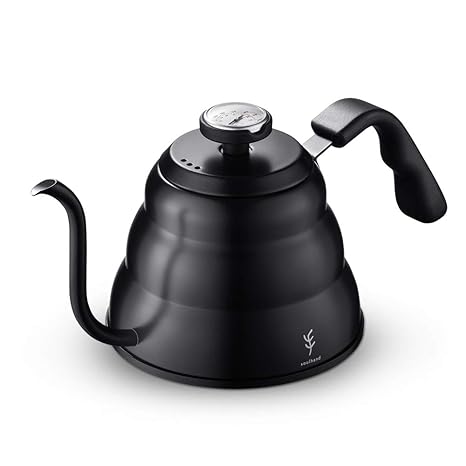
Kettles
Electric kettel, stove-top, or a batch water heater is up to you but look into the reviews of specific kettles and keep a thermometer handy to keep an eye on the temperature.
Roast Profile
Because the pour over method works well to highlight subtle flavor notes and aromas, you may want to choose a light roast. Beans that are roasted to this profile are the brightest, with the most acidic flavors. Chad says “Light roasts showcase the most authentic quality of the coffee.”Of course, you can go medium or even dark if you prefer, but this brewing method is complementary to subtle flavors.

Grind Size
The size of your grounds affects the rate of extraction. Pour over is a an infusion method, which means that the coffee and water are in contact for a shorter amount of time than in an immersion method, but longer than in an espresso. So you want the coffee to have enough surface area to extract before the water filters through into the cup, but not so much that they under-extract and produce a bitter brew.What this means is that you should start with a medium grind size and then evaluate your cup and tweak it as needed. If it’s a little watery or sour, try a finer grind. If it’s bitter and lacking sweet notes, try going a little coarser. And invest in a quality grinder to make sure your coffee particles are all ground to the same size. Lower-quality grinders may produce inconsistently ground coffee and a lot of “fines”. These tiny fragments of coffee extract very quickly and can throw your cup off. “We use finely ground, not coarse,The advantage of the fine grind size is that you increase the body and aroma of the coffee. And if you are going to make a fast extraction, you’re also going to get the sweetness and the cleanliness that you want in the cup.”

What Ratio of Coffee to Water Should You Use?
You’ll see a lot of different suggested ratios out there, but 1litter water and 55-60gr coffee (1g of coffee to 16g of water) is a generally accepted good starting point. Make some brews with this measurement but adjust factors that affect extraction, such as grind size and water temperature, one at a time until you find a recipe that works for you. Then, try changing the ratio of coffee to water. If your brew tastes watery or weak, add more coffee without changing other factors and evaluate whether it tastes better. If you find your cup too intense, consider reducing the amount of coffee. But remember to keep track of what you’re changing so you can replicate your perfect brew when you find it.And don’t forget about the water. Tap water can contain minerals and contaminants that affect flavor, so use filtered water.

Which Pouring Technique Is Best?
Avoid watching too many videos on technique when you first start to brew with the pour over method. It can quickly get overwhelming. Instead, start out simple. Be consistent in how your pour and learn how to use blooming, pulse pouring, and agitation to achieve even extraction. Many people pour in concentric circles, which helps the barista maintain a consistent flow of water. You can work your way up to more detailed methods or break all the rules when you’re more familiar with the basics.
The Bloom
The bloom is the quick bubbling up of water that happens when you first pour. It is caused by the degassing of carbon dioxide that is built up in the roasting process. Light roasts and fresh coffee are likely to produce a big bloom because they usually contain more gases. Carbon dioxide can prevent even extraction because it repels water, and the disturbed grounds can sit at different heights. So let the gases escape and improve your chances of a consistent extraction. Gently pour twice the measure of coffee in water over the grounds. So, if you have a 15 g dose of coffee, pour 30 ml of water. Then wait 30 to 45 seconds until the bloom has ended and the grounds have settled. Don’t make wrong decision ,

Pulse Pouring & Continuous Pouring
Pulse pouring means using multiple pours of specific amounts of water. You can experiment with the volume of water and number of pours. This technique help prevent channeling or grounds rising up the side of the filter. It also gently disrupts the grinds, causing them to move about and creating more even contact with the water. It’s an alternative to continuous pouring, which is when the barista pours the water at as constant of a flow rate as possible without stopping. Continuous pouring aims to keep the flow and saturation as even as possible, whereas pulse pouring is intentionally varied. You can use pouring technique as another variable to consider when adapting your recipe. Different types of pours will have different effects on extraction and therefore have different impacts on your brew.
Agitation
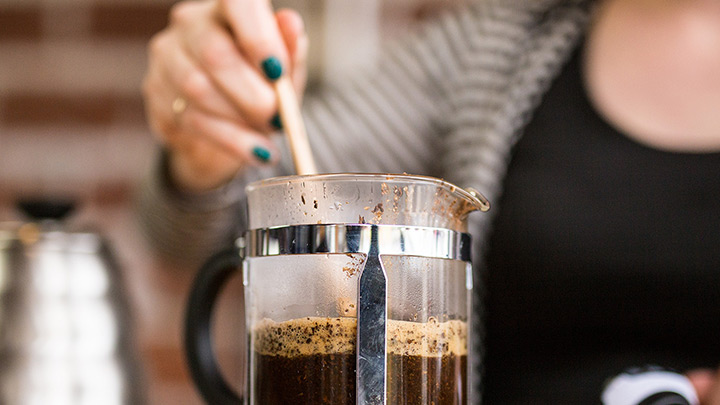
This is simply mild disturbance of the coffee grounds during the brew process. There are many ways to agitate coffee, including stirring or swirling the brew. Agitation disperses grounds that can be left “high and dry” on the filter by channeling. It also breaks up any dry clumps inside the bed of coffee. By making sure all grounds are saturated, agitation aids even extraction. Pour over coffee can be a great way to make your daily cup and it doesn’t have to be complicated. By understanding these key topics, you’re well prepared to make a decent brew and have the tools to tweak it until it becomes a great one.
The post How you can make a better pour over coffee appeared first on Maillardreaction.org.
]]>